A Free Mindfulness Resource for You
This is a free resource for anyone I have taught—past, present, or future. Whether you’ve completed a mindfulness course in one of my classes or are simply curious, you are welcome to use these tools to support your journey.
None of these exercises are my invention—mindfulness is an ancient practice—but they are practical, easy-to-use activities that work in everyday life. I’ve included three of my favourite mindfulness exercises, which I use regularly in the classroom and in my personal life. I never ask anyone to do something I wouldn’t do myself.
Before you begin, remember: you already have everything needed to be a mindfulness master—just like Master Oogway. (If you are curious, watch Kung Fu Panda and observe how different characters face the same challenges.) Master Oogway doesn’t claim to have all the answers, and he is comfortable with “not knowing.” What he does understand is that a calm, clear mind is the key to discovering the answers.
Life consists only of moments, nothing more than that. So, if you make the moment matter, it all matters. Ellen Langer

What is mindfulness?
Mindfulness is a mind
state in which you are paying full attention to the experience
of life, noticing what is happening and to what you think, feel and do.

A Simple Breathing Exercise
Square Breathing
Square breathing is a simple technique to calm the mind and bring focus to the present moment. You can try square breathing while sitting or standing still. Once you are comfortably sitting or standing still, take a few deep breaths.
Breathe in for a count of four. Silently repeat the words, “breathing in.”
-
Hold your breath for a count of four. Silently repeat, “hold 2, 3, 4.”
-
Breathe out for a count of four. Silently repeat, “breathing out.”
-
Hold again for a count of four. Silently repeat, “hold 2, 3, 4.”
Repeat this cycle for four breaths, breathing deeply into your belly. Feel your abdomen expand as you inhale and contract as you exhale. Allow your mind to focus on the rhythm of your breath and the words you silently repeat.

A spot of Self Kindness
Square Breathing with Kindness
Start with square breathing: breathe in, hold, breathe out, hold—each for the same count. This time, during the holding phase, silently repeat a kind comment to yourself. You can even change the kind word with each hold if you like. Continue this cycle until the exercise is complete, noticing how the words and your breath bring calm and presence.
-Breathe in 2, 3, 4;
-Hold and say to yourself, I am a good person;
-Breathe out 2, 3, 4;
-Hold and say to yourself, I believe in myself;
-Breathe in 2, 3, 4;
-Hold and say, I have the confidence to be myself;
-Breath out 2, 3, 4;
-Hold and say to yourself I respect and love myself.
Here are a few self-affirmations to get you started:

Mindfulness and Anger: Noticing, Accepting, Letting Go
What is the opposite of acceptance? Anger. And it’s okay to feel angry—we all do at times. If anger arises, we can simply say to ourselves, “I notice you, anger,” and continue with our day. But when anger overwhelms us, it is often because we are trying to control something we cannot.
So, what is the opposite of anger? Acceptance. Mindfulness can help us tolerate uncomfortable feelings rather than fight them. Thoughts lead to feelings, and feelings lead to actions.
Mindfulness invites us to pause: notice how you feel, ask what thought caused it, and see if you can let it go. Sit with the feeling for a while, acting only when calm. This is not easy, but mindfulness helps us observe our emotions more clearly, and physical exercise can help manage the body’s response to strong feelings.
We can also become curious about our anger—examining thoughts, questioning them, and choosing actions that are considered and kind rather than reactive. With practice, this is possible.
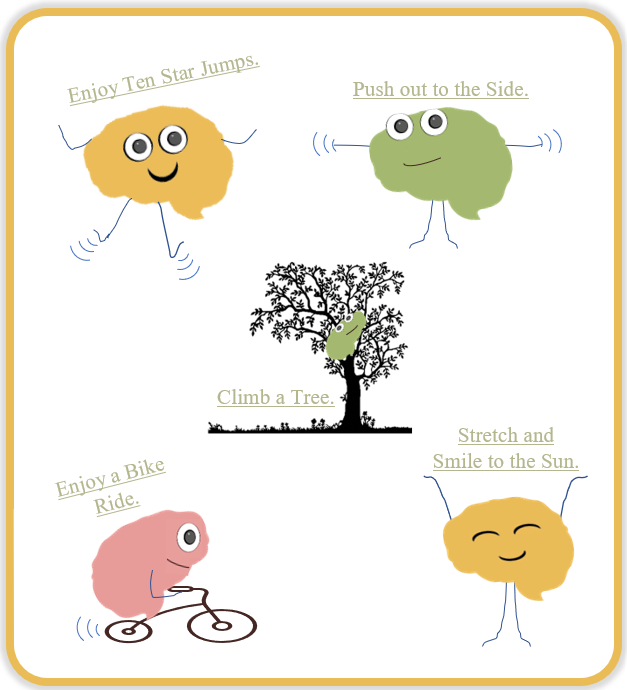
Here’s a simple approach to try: combine a physical activity with a breathing technique. As you breathe in, silently say, “breathing in,” and as you breathe out, say, “breathing out.” You can also replace this with phrases like, “I see you, anger,” or “I see you, frustration.” Notice your feelings, how they shift, and where in your body you feel them. See if the intensity softens.
Mindfulness is about observing, accepting, and gradually letting go—one breath, one moment, one step at a time.
A Final Thought
How do you feel? What did you notice? What have you found easy? Difficult? What activities will you add to your daily, weekly, and monthly routine?
Are you mind full?
or mindful?
